Sustainable in the material: MKN SteelPlus – over 40% CO₂e-reduced stainless steel**Option, Scope 1, 2, 3Find out more ↓
Smiling patient having lunch in her hospital bed

Well cared for, every day. With a kitchen that supports your team.

For patients, mealtimes are a familiar moment in the daily routine of a hospital. For your kitchen team, they are a demanding task every day: many special diets, fixed times, limited resources. The right cooking technology depends on your catering concept.

Discuss your hospital kitchen with usFind your starting point

A piece of everyday life in a place with little everyday life.

In hospital, others decide many things. The meal remains a familiar moment – a taste you know, a choice you make yourself.

For the kitchen, this means that different diets, portion sizes and textures must be reliably implemented every day – in line with the requirements of the nutrition team, and so that the food arrives appetisingly on the plate.

Image placeholder: appetisingly presented meal on a patient tray, or kitchen team portioning

Good food. Fixed times. Tightly calculated resources.

Hospital catering must take individual needs into account and be economical at the same time. In production, large batches meet small quantities for special diets. In regeneration, different meals must be ready within the scheduled serving window. The right cooking technology supports these processes and relieves the team of recurring tasks.

Costs
Rising costs per patient day on a limited budget.
Staff
Skilled staff are scarce – processes must also work with changing teams.
Quality
Food and service should be consistently good across many special diets.
Hygiene and digitalisation
Processes must be safe, traceable and documented.
Where does your kitchen come in?
Production
“We produce meals.”
In our own hospital kitchen – or in our central kitchen supplying several facilities.
Large batches, special diets and fixed serving times – using cook & serve or cook & chill.
Regeneration and serving
“We regenerate and serve.”
For supplied hospitals, distribution and ward kitchens.
Chilled or frozen meals, a tight serving window – and staff without culinary training who work safely with stored programmes and fixed routines.

From cooking to serving. Which steps does your kitchen take on?

Many hospitals prepare meals in their own kitchen. Cook & serve and cook & chill are common methods and partly complement each other. Not every hospital goes through the same steps.

1
Production
Cooking, boiling, braising – in large batches and small quantities for special diets.
2
Provision
Straight to portioning – or, depending on the method, chilling, storage and transport.
3
Regeneration
Where the concept provides for it: centrally, in the distribution kitchen or on the ward.
4
Serving
Portioning, distributing, serving – at fixed mealtimes.

Not every kitchen takes on all four steps itself. Organisational form, production method and place of regeneration are three separate decisions:

For whom?
For the hospital itself, for several facilities – or meals are bought in.
How?
Cook & serve, cook & chill or cook & freeze – each method has its place, depending on local conditions.
Where?
Whether meals are produced in your own kitchen or delivered food is regenerated determines which technology is placed where and how it is used.
Production

You produce meals. For your own hospital or several facilities.

The production kitchen lays the foundation for every meal. The task is rarely just “cooking a lot”: large main batches, small quantities for special diets and fixed serving times all have to fit together.

Task
What this means
Contribution of MKN technology

Large main batches and special diets

Alongside the main components, small quantities for special diets are prepared – often in the same time window.
FlexiCombi® cooks components in large batches. The specialists of the MKN OPTIMA® cover both sides: boiling pans with large capacities of up to 500 litres for the main components – and fast induction for individual small quantities for special diets.

Parallel processes, fixed serving times

Portioning, chilling or distribution start at fixed times. Several processes must be finished at the same time.
FlexiCombi® and FlexiChef® support different production tasks. The specialists of the MKN OPTIMA® – such as an induction range or a boiling pan – add capacity precisely where tasks run at the same time.

Batch planning, preparation and ergonomics

Batches are prepared according to the production plan. Stirring, lifting, loading – these heavy, recurring tasks put a strain on the team.
The FlexiMix® takes over stirring large quantities. Easy Lift on the FlexiChef® and on the MKN OPTIMA boiling pan® makes emptying easier. Side-loading racks make it easier to load the combi steamers.

Automatic stirring, reproducible programmes

Large quantities of soups, sauces or purées would otherwise demand constant attention at the kettle.
FlexiMix® cooks and stirs automatically. Stored cooking programmes support consistent results.

Supplying several hospitals: scaling up production

As volumes grow, the entire process has to scale with them – from cooking and chilling to transport and serving. Simply multiplying recipe quantities is not enough.
Cooking capacity and batch sizes must be aligned with the downstream steps such as chilling and transport. MKN provides the expertise to help coordinate the entire process. Thanks to fully automatic SpaceClean® cleaning, the FlexiChef® is quickly ready for use again – so production can resume whenever additional meals are needed at short notice.
Reference: own production
Regeneration and serving

You regenerate and serve. In supplied hospitals, distribution and ward kitchens.

Regeneration kitchens also need sufficient capacity – just measured differently: what matters is how many plates or containers must be ready within the serving window, and who operates the appliances.

Task
What this means
Contribution of MKN technology

Different starting conditions

Meals arrive chilled or frozen. Each requires its own programmes.
Regeneration programmes matched to the respective starting condition.

Food, containers, loading and programmes

The recipe, the plates or containers used, how they are loaded and the regeneration programme all influence the final result.
We work with you to optimise recipes, containers, loading and regeneration programmes to achieve the best possible results.

Capacity within the serving window

All meals for a ward must be ready within a tight time window.
Using our appliance data, we show which appliance size and which accessories, such as FlexiRack, match the number of plates or containers per cycle.

Operation by service or kitchen staff

Regeneration is often carried out by staff without culinary training.
Preconfigured programmes can be started at the touch of a button.

Reliable process right up to serving

Every meal should reach the patient in the same quality.
Reproducible programmes support consistent results and a predictable process.
Ward regeneration is one possible solution, not the model for every hospital. The right technology depends on the meal distribution system – whether regeneration takes place on plates, in GN containers or in regeneration trolleys. Where combi steamers are suitable, FlexiCombi® or, where space is limited, the SpaceCombi® can be used – a full-size combi steamer just 55 cm wide.

The MKN hospital kitchen. Different requirements. One MKN total solution.

Many special diets, different batch sizes and fixed times for portioning and distribution: the technology must suit the way your kitchen works. FlexiChef®, FlexiCombi® and FlexiMix® combine several functions and support different production tasks. The specialists of the new MKN OPTIMA® add capacity precisely for individual tasks. Together, they form an equipment line-up that brings quantities, time windows and parallel processes together – developed and manufactured in Wolfenbüttel, Germany.

Process first. Then technology.

Multifunctional all-rounders – several functions for different production tasks
State-of-the-art specialists – targeted capacity for individual tasks
MKN FlexiCombi combi steamer
Multifunctional all-rounder · Production and regeneration

FlexiCombi®

Versatile cooking, precise regeneration
Cooking components in larger quantities – and, in suitable concepts, regenerating prepared meals.
Stored programmes: reproducible cooking processes, matched to your recipes
Guided operation: start preconfigured programmes at the touch of a button
WaveClean®: cleaning programmes for the cooking chamber
Versions: Available in different appliance sizes and GN formats – also as a team version with two independently usable cooking chambers. Where space is limited: SpaceCombi® as a full-size combi steamer just 55 cm wide.
MKN FlexiChef
Multifunctional all-rounder · Production

FlexiChef®

Changing tasks throughout the day
From goulash to soups, sauces and side dishes: braising, boiling and other cooking processes in one appliance.
FlexiZone®: up to three separately controllable cooking zones in one pan
Versatile: one position for several production tasks a day
HighSpeed cooking: for short cooking times with suitable dishes
SpaceClean®: fully automatic cleaning, quickly ready for the next task
MKN FlexiMix boiling pan with agitator
Multifunctional all-rounder · Production

FlexiMix®

Cooking large quantities with automatic stirring
Soups, stews, sauces and suitable purées in plannable batches. While the agitator is running, the team can take on other tasks.
Three-part agitator: requires less manual attention
Cooking programmes: support consistent results
Low pouring height: makes emptying easier
Whether recipes and textures are suitable for specific diets is checked by specialists – it is not determined by the appliance.
Versions: 7 kettle sizes from 80 to 475 litres.
The new MKN OPTIMA
State-of-the-art specialist · Production

MKN OPTIMA®

Targeted capacity for individual tasks
Classic cooking technology, reinvented: boiling pans, induction ranges, bratt pans and other specialist appliances take on individual tasks wherever the process needs its own capacity – from the kettle for large quantities to the range for sauces and special diets.
OPTIMA Control: familiar control knob, complemented by a display with timer; core temperature probe optional for certain appliances
Induction Efficiency Control: intelligence that also checks the cookware
Boiling pans: automatic water filling accurate to the litre, as standard
Equipment: Induction ranges, boiling pans and other specialist appliances can be combined into one line.
Image placeholder: large MKN OPTIMA cooking block, ideally a double block, with integrated FlexiChef – boiling pan, induction and bratt pan, no fryer
All-rounders and specialists in one line

A cooking block that suits the way you work.

The specialists of the MKN OPTIMA® can be combined with the FlexiChef® to form a cooking block – also as a double block. The FlexiChef® integrates neatly into the line.

Suitable for plinth installation
Wall-mounted installation on request
Neat line integration of the FlexiChef®
Not every hospital kitchen needs all four product families. The right combination depends on the menu, special diets, batches, simultaneous processes, production times, space, staff and the route to the point of service.
Discuss your hospital kitchen with us
MKN Connected Kitchen on laptop, tablet and smartphone

Connected in operation. Transparency across your MKN appliances.

Overview of all connected MKN appliances – including across several sites
Manage cooking programmes centrally and transfer them to connected appliances
View operating and consumption data and use it for improvements
Cooking process data that supports your HACCP documentation

MKN Connected Kitchen® refers to the connected MKN appliances. Patient ordering, inventory management and food logistics run on your own systems; HACCP responsibility remains with the operator.

More about MKN Connected Kitchen®
MKN SteelPlus – over 40% CO₂e-reduced stainless steel
MKN SteelPlus – over 40% CO₂e-reduced stainless steel*
Sustainable in the material
By purchasing the MKN SteelPlus option, MKN commits to processing CO₂e-reduced stainless steel in its production in line with your order. The ordered appliance itself is not necessarily made from CO₂e-reduced stainless steel.
The CO₂e saved through your purchase is confirmed – a verifiable contribution to your hospital's sustainability targets.
*Option, Scope 1, 2, 3More about MKN SteelPlus

Proof in practice. Different concepts, the right technology.

Own production on site – and, as a special case, regeneration in a combi steamer directly on the ward: the examples show how different the right solution can look.
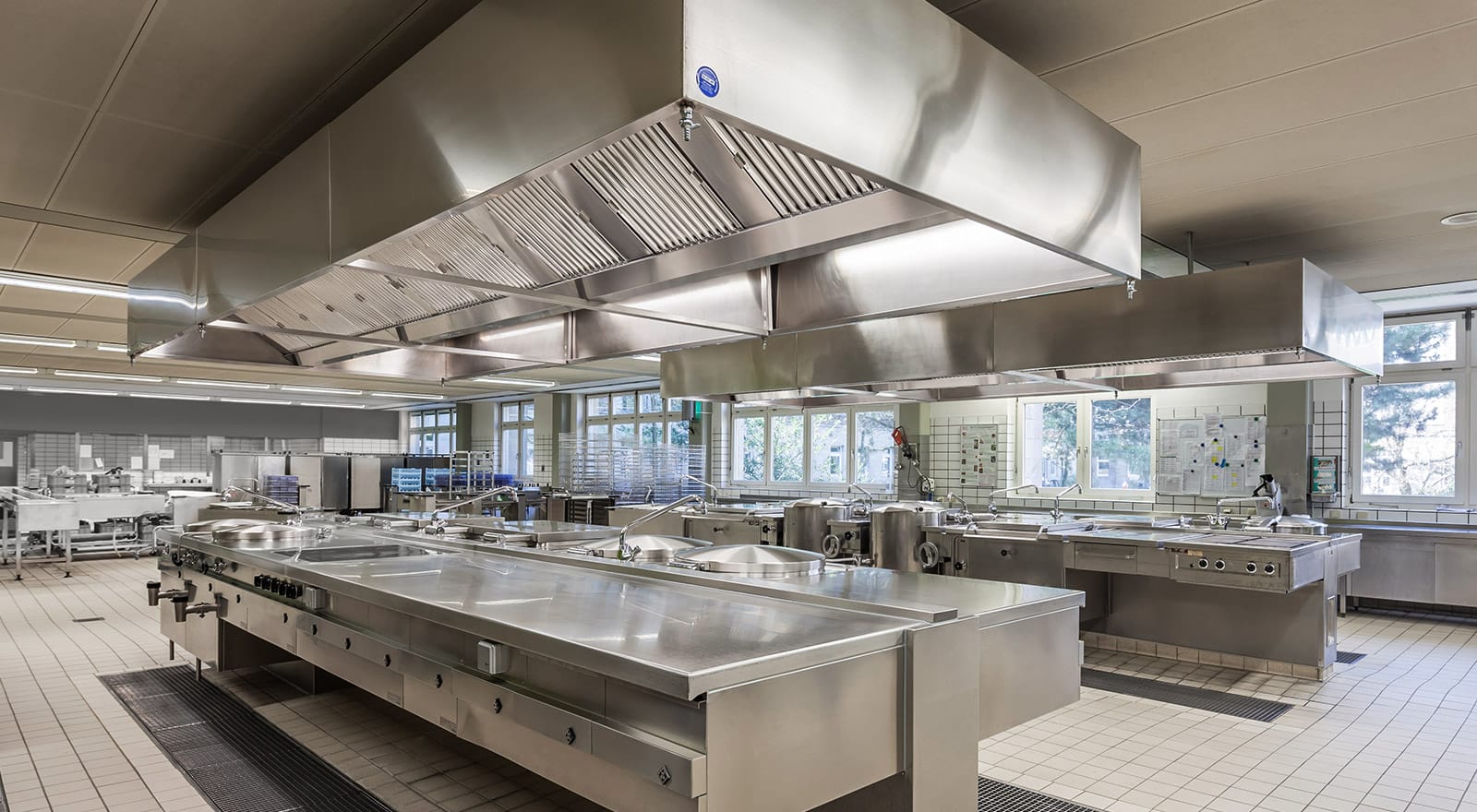
Kitchen of Braunschweig Municipal Hospital with MKN cooking technology
Reference · Own production

Braunschweig Municipal Hospital

Cooking fresh on site. Organising catering in-house.
Today
With three sites, one of the largest hospitals in northern Germany. According to the hospital, the teams in its two kitchens prepare meals fresh on site.
Equipment
Since the modernisation in early 2018, the kitchens have been working with MKN combi steamers and a MasterLine cooking suite.
Service assistant taking a patient's meal order on the wardInterview on the ward kitchen concept (in German)Watch the video on YouTube
Frankfurter Rotkreuzkliniken · The video opens on YouTube.
Special case · Regeneration in a combi steamer

Frankfurter Rotkreuzkliniken

Choose on the same day. Regenerate directly on the ward.
20
dishes to choose from every day, plus special menus
up to 24
different menus at the same time in one appliance
up to 36
plated meals at the same time in the reference set-up described
Starting point
Two sites in Frankfurt am Main: Klinik Rotes Kreuz and Klinik Maingau. At the end of 2023, the hospitals introduced a new catering concept with three goals: more flexibility for patients, greater satisfaction and relief for nursing staff. Ordering lead times of up to several days were to be eliminated.
Catering concept
Food supply was switched to a just-in-time concept. Patients choose at short notice from 20 dishes and additional special menus; new admissions and spontaneous changes can also be taken into account. Meals are regenerated on the wards immediately before serving.
Role of MKN technology
Together with MKN, a multi-stage regeneration programme was developed that combines different requirements for temperature, steam and cooking time in one standardised process. Even plates and cloches, the spacing of the shelf grids and the fixing of the cleaning cartridge were taken into account. The programme is started at the touch of a button – even by staff without technical kitchen qualifications. FlexiCombi® combi steamers are used.
Result
Standardised regeneration processes ensure stable, consistent food quality and relieve staff. For an average ward with around 30 to 32 beds, one appliance per ward is sufficient in the set-up described. In addition to the regeneration result, the cooperation with MKN and energy efficiency were decisive factors for the hospitals.

“The quality is now much more stable and consistent than it used to be, because it is always the same process.”

Titus Kinsler, Head of Facility and Supply Services, Frankfurter Rotkreuzkliniken

Cost-efficient in everyday operation. What pays off depends on your concept.

A kitchen becomes cost-efficient when appliances are well utilised and recurring work is reduced. These factors are decisive:

If you produce
Batch size: how much per batch and how often a day
Simultaneous capacity: which processes must run in parallel
Appliance utilisation: which appliances take on several tasks over the day
Labour time: where programmes and automatic stirring relieve the team
Cleaning: cleaning programmes and readiness for the next task
Serving times: by when meals must be ready for portioning, chilling or transport
If you regenerate
Appliance capacity: which appliance size and accessories follow from this
Plates or containers per cycle: how many meals per cycle
Serving window: how many cycles are possible before mealtime
Operating effort: who regenerates and how many steps are required

Replace, add, convert or plan from scratch?

Replace existing equipment
Which tasks do the old appliances perform today – and could they be distributed differently in future?
Add missing capacity
Will another multifunctional appliance close the gap – or a specialist that adds capacity for one specific task?
Change the production system
Switching to cook & chill or to supplying several hospitals changes batches, times and technology.
Plan a new kitchen
Catering concept, menu and special diets form the basis for choosing the appliances.

Existing connections, ventilation, routes and catering during the conversion should be considered early in the planning – modernisation is often possible step by step.

Kitchen planning is the responsibility of your kitchen planner. MKN contributes its know-how about cooking processes and appliances: we show what our technology can do, answer questions about its use and provide the planner with technical appliance data.

Which technology supports your hospital kitchen?

Together with you and your kitchen planner, we tailor MKN cooking technology to your quantities, special diets and processes. Tell us how your catering is organised today and what you would like to change.

Helpful but not required: number of meals, special diets, production or serving times, space and existing equipment.

Request advice on your hospital kitchen